

Balancing inflation against a weakening economy, Bank of Canada holds interest rates again
Jenny Wang
June 10, 2026
Key takeaways
- The Bank of Canada decided to leave its policy interest rate unchanged in June.
- The decision comes as inflation rises and labour data strengthens, offset by a weakening economy.
- We maintain our overall positive view on equities relative to fixed income and cash.
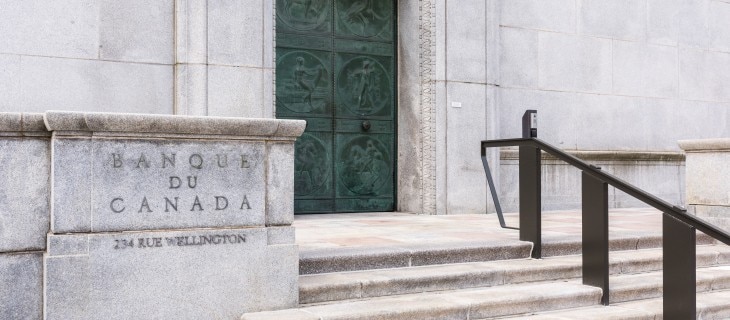
Following its June monetary policy meeting, the Bank of Canada (BoC) announced that it would hold its policy interest rate at 2.25%. The decision was widely anticipated and marks the fifth consecutive meeting where the Bank left rates unchanged. The BoC justified its approach, balancing a Canadian economy that’s in a technical recession (two consecutive quarters of contraction), uncertainty regarding the outcome of upcoming Canada-U.S.-Mexico Agreement (CUSMA) talks, the ongoing conflict in the Middle East that’s pushing energy prices higher, disrupting supply chains and elevating inflation.
At this time, we remain convinced that the BoC will hold interest rates steady over the near term.
Canadian economic data is lukewarm
Following a decline in the fourth quarter of 2025 (-0.2%), Canadian gross domestic product (GDP) contracted again in the first quarter of 2026 (-0.1%)—notable because this is weaker than what the BoC projected in April. “Recent data suggests that growth will resume in the second quarter but, even with some rebound, the economy is expected to remain in excess supply,” said the Bank. Consumer spending increased, offset up an unexpected decrease in government spending. Employment showed improvement in May but remains volatile month-to-month.
Spiking inflation: Temporary or trend?
Unsurprisingly, consumer price index (CPI) inflation rose to 2.8% in April, reflecting both higher energy prices and the drop off of data impacted by the consumer carbon tax from 12-month inflation readings. With that said, the BoC continues “to look through the war’s near-term impact on headline inflation but will not let higher energy prices become persistent inflation,” and it believes that “there has been limited evidence of broad-based pass-through of higher energy prices to other consumer prices.”
We remain steadfast in our management approach
The strategic asset allocation of the portfolios we manage for our clients remains unchanged at this time. These portfolios are built around long-term goals, long-term time horizons and long-term capital market expectations, and that remains little changed.
Focusing on the next 12-to-18 months, where opportunities and risks become clearer, we continue to be overweight equities relative to fixed income and cash in our clients’ portfolios with a tactical asset allocation overlay.
The current environment really reinforces the value of professional portfolio management and diversification across multiple asset classes, regions, styles and sectors. As always, we will continue to watch how things develop, how policy makers respond, how businesses adjust and more. While the conflict in the Middle East is unfortunate and regrettable, geopolitical tension and war are not unfamiliar to us as portfolio managers—we have a well-established playbook on how we monitor, assess and respond.
The next BoC interest rate announcement is scheduled for July 15th and will be accompanied by an updated Monetary Policy Report.
Jenny Wang
Jenny Wang, CFA, MA Economics, is a Portfolio Manager with the Multi-Asset Management Team. She is a member of the total portfolio management sub-team and her primary focus is on fixed income investments.
Commissions, trailing commissions, management fees and expenses may be associated with mutual fund investments. Please read the prospectus before investing. Mutual funds are not guaranteed or insured by the Canada Deposit Insurance Corporation or any other government deposit insurer; their values change frequently, and past performance may not be repeated.
This publication is provided for information purposes only. It is not to be relied upon as financial, tax or investment advice or guarantees about the future, nor should it be considered a recommendation to buy or sell. Information contained in this document, including information relating to interest rates, market conditions, tax rules, and other investment factors, are subject to change without notice, and The Bank of Nova Scotia is not responsible to update this information. All third-party sources are believed to be accurate and reliable as of the date of publication, and The Bank of Nova Scotia does not guarantee its accuracy or reliability. Readers should consult their own professional advisor for specific financial, investment and/or tax advice tailored to their needs to ensure that individual circumstances are considered properly and action is taken based on the latest available information. This publication may contain forward-looking statements based on current expectations and projections about future general economic factors. Forward-looking statements are subject to inherent risks and uncertainties which may be unforeseeable and such expectations and projections may be incorrect in the future. Forward-looking statements are not guarantees of future performance and you should avoid placing undue reliance upon them. This publication and all the information, opinions and conclusions contained herein are protected by copyright. This publication may not be reproduced in whole or in part without the prior express consent of The Bank of Nova Scotia.
Scotia Global Asset Management is a business name used by 1832 Asset Management L.P., a limited partnership, the general partner of which is wholly owned by Scotiabank.
Scotiabank® includes The Bank of Nova Scotia and its subsidiaries and affiliates, including 1832 Asset Management L.P. and Scotia Securities Inc.
ScotiaFunds® are managed by Scotia Global Asset Management.
ScotiaFunds are available through Scotia Securities Inc. and from other dealers and advisors. Scotia Securities Inc. is wholly owned by The Bank of Nova Scotia and is a member of the Canadian Investment Regulatory Organization.
® Registered trademarks of The Bank of Nova Scotia, used under licence.
© Copyright 2026 The Bank of Nova Scotia. All rights reserved.