
When diesel prices rise, how far can inflation travel?
Examining how higher diesel prices can impact the broader economy.
Key takeaways:
- A recent Scotiabank Economics report finds that the rising price of diesel can contribute to broader inflation pressures beyond their direct impact on energy prices.
- Transportation prices tend to respond first, while the effects on areas such as food and shelter can emerge later as higher costs move through supply chains.
- A prolonged diesel-price shock could increase the risk of more persistent inflation, potentially making the inflation outlook more challenging
Oil prices are often closely watched as a driver of inflation, but a closer look at diesel prices can reveal how energy costs are filtering through the broader economy.
Following the Iran war, diesel prices have risen by more than the increase in crude oil would typically suggest, reflecting transportation challenges in the Middle East and reduced Russian refining capacity linked to the conflict in Ukraine.
Price increases matter because diesel plays an important role throughout the economy. Trucks, farm machinery and construction equipment all rely on diesel, making it a key input across transportation, agriculture, construction and other parts of the supply chain. As those costs rise, some of the pressure can eventually reach consumers through higher production and distribution costs.
An October 5, 2026 report from Scotiabank Economics examines how diesel-specific price shocks can work their way through inflation in Canada and the United States. The analysis separates movements in diesel prices that cannot be explained by changes in crude oil and then tracks their impact across consumer and producer prices.
The findings suggest the effects can extend beyond energy. For a temporary increase of about 15% in the diesel spread, similar to the increase observed at the time of the report, the analysis estimates an impact of 0.6 percentage points on Canadian CPI inflation and 0.8 percentage points in the United States.
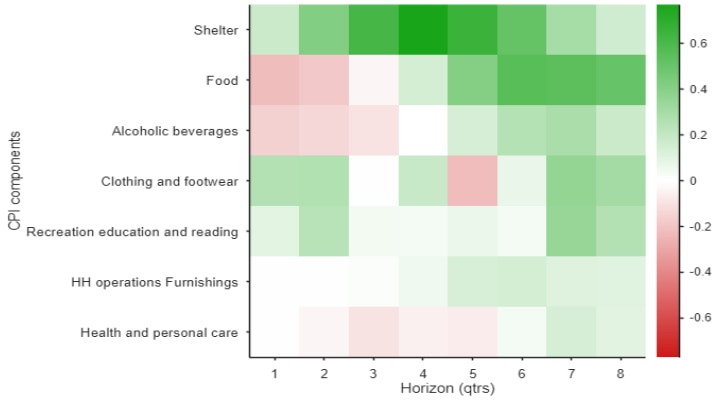
Importantly, the impact does not occur all at once. Transportation-related prices tend to react earlier, while other categories can take considerably longer. The effects across Canadian Consumer Price Index (CPI) categories can also emerge at different points following a diesel-price shock (see chart). In Canada, the report finds that the effect on shelter prices peaks roughly one year after a diesel shock, while the impact on food prices peaks around 18 months later.
Chart: Most Components of Canadian CPI Reaction Peaks After a Year
Source: Scotiabank Economics
For investors and advisors, the analysis highlights that this energy price shock could have implications beyond headline energy prices, particularly given the rise in diesel prices. The report notes that central banks may be able to look through a temporary relative-price shock, but one that contributes to broader price pressures or inflation expectations is harder to ignore for monetary policy.
“Overall, the evidence points to a clear inflationary impact from diesel-specific shocks,” writes Olivier Gervais, Director, Modelling and Forecasting at Scotiabank. “The important caveat is that our analysis treats the diesel shock as temporary; it does not fully capture what happens when the shock persists or begins to influence expectations. The inflation consequences could be meaningfully larger if firms and households come to expect elevated energy costs to last.”
Read the full Scotiabank Economics report to learn more.
Commissions, trailing commissions, management fees and expenses may be associated with mutual fund investments. Please read the prospectus before investing. Mutual funds are not guaranteed, their values change frequently, and past performance may not be repeated.
This publication is provided for information purposes only. It is not to be relied upon as financial, tax or investment advice or guarantees about the future, nor should it be considered a recommendation to buy or sell. Information contained in this document, including information relating to interest rates, market conditions, tax rules, and other investment factors, are subject to change without notice, and Scotia Global Asset Management is not responsible to update this information. All third-party sources are believed to be accurate and reliable as of the date of publication, and Scotia Global Asset Management does not guarantee its accuracy or reliability. Readers should consult their own professional advisor for specific financial, investment and/or tax advice tailored to their needs to ensure that individual circumstances are considered properly and action is taken based on the latest available information. This publication may contain forward-looking statements based on current expectations and projections about future general economic factors. Forward-looking statements are subject to inherent risks and uncertainties which may be unforeseeable and such expectations and projections may be incorrect in the future. Forward-looking statements are not guarantees of future performance and you should avoid placing undue reliance upon them. This publication and all the information, opinions and conclusions contained herein are protected by copyright. This publication may not be reproduced in whole or in part without the prior express consent of Scotia Global Asset Management.
Scotia Global Asset Management is a business name used by 1832 Asset Management L.P., a limited partnership, the general partner of which is wholly owned by Scotiabank.
ScotiaFunds® are managed by Scotia Global Asset Management.
ScotiaFunds are available through Scotia Securities Inc. and from other dealers and advisors. Scotia Securities Inc. is wholly owned by The Bank of Nova Scotia and is a member of the Canadian Investment Regulatory Organization.
® Registered trademarks of The Bank of Nova Scotia, used under licence.
© Copyright 2026 The Bank of Nova Scotia. All rights reserved.