

Keeping pace with Canada’s aging reality
Is the country’s retirement framework ready to support a rapidly aging population?
Key takeaways:
- A Scotiabank Economics report examines whether Canada's Old Age Security program remains aligned with the country's changing demographic realities.
- Population aging may place additional pressure on public services, retirement programs and government finances over the coming decades.
- The report explores potential reforms that could encourage retirement saving earlier in life while providing income support later in retirement.
How prepared is Canada for a much older population?
Canada has not yet reached peak aging, but demographic pressures are already mounting. Nearly one in five Canadians is over age 65 today, and that share is expected to rise in the decades ahead. Longer lifespans, increasing healthcare costs and growing demand for home and long-term care are placing added pressure on public systems.
Against this backdrop, a recent Scotiabank Economics report examines whether Canada's retirement policy framework remains suited to the realities of an aging population.
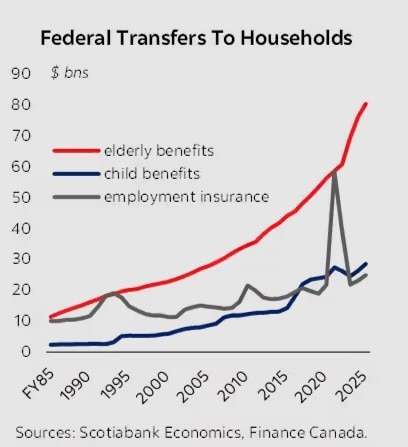
The report focuses on Old Age Security (OAS), a cornerstone of Ottawa’s retirement income system. OAS provides income support to millions of Canadians, but it was created for a younger country with shorter life expectancy and far fewer seniors. Today, OAS represents a significant share of federal household transfers, with costs projected to continue rising as the population ages (see chart).
Rather than revisiting past debates over eligibility or benefit levels, the report explores whether a different approach could better align retirement support with modern longevity trends. One idea would allow Canadians to receive retirement-focused savings credits earlier in their working years, with part of those savings later converted into pooled lifetime income. According to the report, such a model could help build retirement assets over time while providing greater protection against longevity risk.
For investors and advisors, the analysis highlights the connection between demographic trends, retirement policy and long-term financial planning. As governments grapple with affordability challenges and an aging population, retirement planning will increasingly depend on diversified income sources, disciplined saving and investing, and flexible withdrawal strategies.
“Longer lives should be a gain in wellbeing, not a growing source of worry,” writes Rebekah Young, Vice President, Economic Policy at Scotiabank. “Putting redesign on the table should not be about revisiting old ideological fights. It should be framed as an opportunity to give Canadians across the lifecycle a more credible and practical financial foothold in an era of longevity—one they may judge less at the ballot box than in their own pocketbooks.”
Read the full Scotiabank Economics report to learn more.
Commissions, trailing commissions, management fees and expenses may be associated with mutual fund investments. Please read the prospectus before investing. Mutual funds are not guaranteed or insured by the Canada Deposit Insurance Corporation or any other government deposit insurer, their values change frequently and past performance may not be repeated. The indicated rates of return are the historical annual compounded total returns, including changes in unit value and reinvestment of all distributions and do not take into account sales, redemption, distribution or optional charges or income taxes payable by any security holder that would have reduced returns. Mutual funds are not guaranteed, their values change frequently, and past performance may not be repeated.
This document has been prepared by Scotia Global Asset Management and is provided for information purposes only.
Views expressed regarding a particular investment, economy, industry, or market sector should not be considered an indication of the trading intent of any of the mutual funds managed by Scotia Global Asset Management. These views are not to be relied upon as investment advice, nor should they be considered a recommendation to buy or sell. These views are subject to change at any time based on markets and other conditions, and we disclaim any responsibility to update such views. Information contained in this document, including information relating to interest rates, market conditions, tax rules, and other investment factors are subject to change without notice, and Scotia Global Asset Management is not responsible to update this information. Nothing in this document is or should be relied upon as a promise or representation as to the future.
This report may contain forward-looking statements. Such statements are predictive in nature and depend upon or refer to future events or conditions. Any statement regarding future performance, strategies, prospects, actions or plans is also a forward-looking statement. Forward-looking statements are subject to known and unknown risks and uncertainties and other factors that may cause actual results, performance, events, activity, and achievements to differ materially from those expressed or implied by such statements. Such factors include general economic, political and market conditions, interest, and foreign exchange rates, regulatory or judicial proceedings, technological change, and catastrophic events. You should consider these and other factors carefully before making any investment decisions and before relying on forward-looking statements. We have no specific intention of updating any forward-looking statements, whether because of new information, future events or otherwise.
Scotia Global Asset Management® is a business name used by 1832 Asset Management L.P., a limited partnership, the general partner of which is wholly owned by Scotiabank.
® Registered trademarks of The Bank of Nova Scotia, used under licence.
© Copyright 2026 The Bank of Nova Scotia. All rights reserved.