

Market Volatility: Strait of Hormuz closed for business
Myles Zyblock
March 6, 2026
Mid-day today, the S&P 500 and global equities were both down by about 1%. The equity drawdown since the beginning of the conflict has been rather mild, at least so far. We find that the typical drawdown for the S&P 500 in the face of geopolitical conflict from WWII onwards has been about 6% spread over 16 trading days. Each conflict through time has had its own set of unique circumstances which makes such generalizations about “typical” behavior somewhat questionable. That said, it is important to keep in mind that 80% of these episodes resolved positively (average gains of 15.8%) for equity investors with a 1-year time horizon.
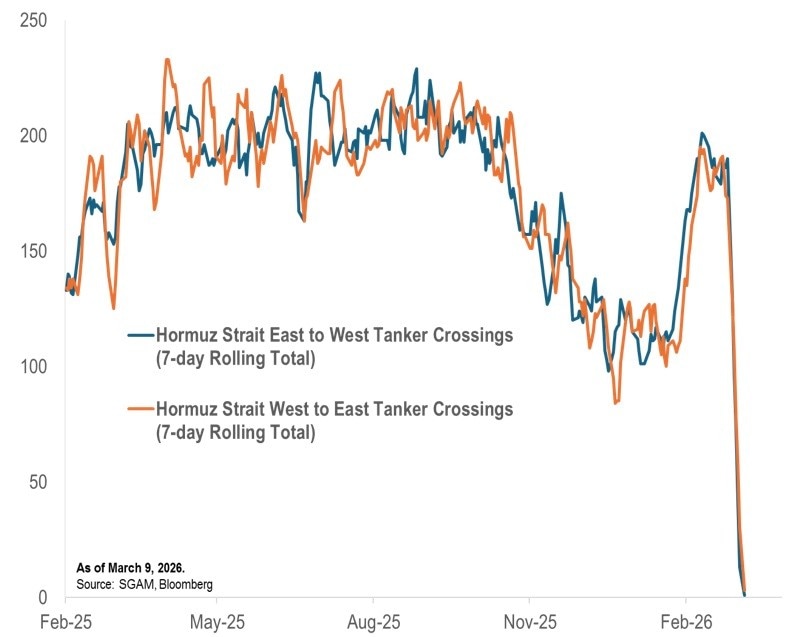
For financial markets, oil is a central focus given the current battle. The price of brent is up by 7% and WTI has rallied by an even larger 11% as the clock strikes noon EST. It has become concerning to many market watchers that traffic in the Strait of Hormuz, where ~20% of global petroleum liquids transit through it daily, has come to a complete standstill. The latest data shows that no ships – either in an eastward or westward direction - are now operating in the Strait.
The WTI crude oil price has jumped by 33% to $89/bbl since late February. Historically speaking, oil prices have had to rise by somewhere between 75-100% before the U.S. economy finds itself in more serious trouble. While the economy has become less energy intensive and import dependent over time, the longer that this oil price surge persists the more likely we are to see the appearance of stress. Meanwhile, markets are beginning to price for somewhat higher inflation due to the sharp increase in energy costs.
While it is much too soon to be concerned about serious or lasting economic fallout from conflict in the Middle East, the risks are rising for a scenario which contains somewhat higher inflation and lower economic growth. As we continue to stress, a diversified portfolio is one of the best first lines of defense against economic and financial market uncertainty.
This publication is provided for information purposes only. It is not to be relied upon as financial, tax or investment advice or guarantees about the future, nor should it be considered a recommendation to buy or sell. Information contained in this document, including information relating to interest rates, market conditions, tax rules, and other investment factors, are subject to change without notice, and The Bank of Nova Scotia is not responsible to update this information. All third-party sources are believed to be accurate and reliable as of the date of publication, and The Bank of Nova Scotia does not guarantee its accuracy or reliability. Readers should consult their own professional advisor for specific financial, investment and/or tax advice tailored to their needs to ensure that individual circumstances are considered properly and action is taken based on the latest available information. This publication may contain forward-looking statements based on current expectations and projections about future general economic factors. Forward-looking statements are subject to inherent risks and uncertainties which may be unforeseeable and such expectations and projections may be incorrect in the future. Forward-looking statements are not guarantees of future performance and you should avoid placing undue reliance upon them. This publication and all the information, opinions and conclusions contained herein are protected by copyright. This publication may not be reproduced in whole or in part without the prior express consent of The Bank of Nova Scotia
Scotia Global Asset Management is a business name used by 1832 Asset Management L.P., a limited partnership, the general partner of which is wholly owned by Scotiabank.
Scotiabank® includes The Bank of Nova Scotia and its subsidiaries and affiliates, including 1832 Asset Management L.P. and Scotia Securities Inc.
® Registered trademarks of The Bank of Nova Scotia, used under licence.
© Copyright 2026 The Bank of Nova Scotia. All rights reserved.